


 October 22nd, 2012
  admin
admin 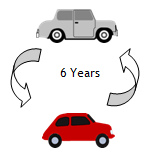
Use the Savings to Speed Past Other Debts
I was taught to set goals that are challenging but achievable. Accordingly, I set a goal to keep a car for 12 years before burying it. A few decades ago that would have been unrealistic but thankfully today’s vehicles, if properly maintained, can run for 200,000 miles or even more.
This is good news for the frugal. It enables us to lower our car costs and free up cash flow by spreading out and staggering vehicle purchases. For example, if you live in a 2-car household, here’s a schedule to consider following (it’s the one my wife and I follow):
• Now through year 6: Household member 1 buys a car, takes out a loan and pays it off in 3 years.
• Year 6: Household member 2 buys a car, takes out a loan and pays it off in 3 years.
• Year 12: Household member 1 replaces 12-year-old car with a new one; takes out a loan and pays it off in 3 years.
• Year 18: Household member 2 replaces 12-year-old care with a new one: takes out a loan and pays it off in 3 years.
• And so on…
This allows you to spread out new car purchases every 6 years. And because each car is paid off in 3 years, you never have more than one car payment to make, and 50% of the time you don’t have any. If we assume an average loan or lease payment of $400/month, every 3 years when you have no payments you can save $12,000, or $24,000 in a single 12-year cycle.
Of course if you’re a 1-vehicle household this approach wouldn’t apply, but the principle remains the same. Buy a vehicle and pay it off quickly, then start saving.
So take financial advantage of advances in automobile technology. Change the oil regularly, free up cash flow, and use it to get further ahead on other debts.
P.S. Remember: Don’t buy an unnecessarily expensive car. “Worst” asset types should be functional, not lavish!
 Keith Whelan is Cashflownavigator's founder and author of the "Wealth is Good, Cash Flow is Better" e-booklet. He is a graduate of Columbia University Business School, teaches at Rutgers University, and has over 30 years experience in the banking and financial services industry. Keith, his wife Cindy, and their two sons live in New Jersey.
 Posted in
  Tags:
Tags:  Loading ...


