


 September 19th, 2012
  admin
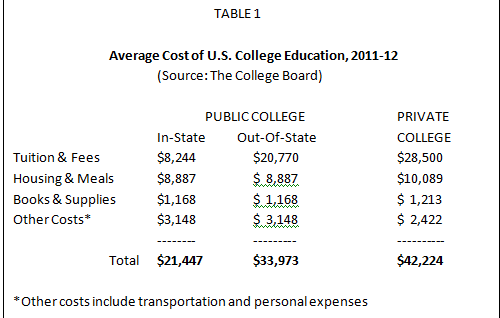
admin  It now costs an average of $21,447 a year to attend an in-state public college, and over $42,000 a year for a private college. To make matters worse, these costs are rising rapidly. During the past decade they rose 5.6% per year faster than inflation. (1) That’s a nasty combination, particularly if you’re the one paying the bill.
If you’re a student paying your own way this extra cost could jeopardize your ability to get ahead of debt at an early age. If you’re a parent paying for your children’s education the additional obligation might set you back on your path to financial freedom, perhaps by years.
This expense is too big to accept without looking for ways to reduce it. Here are a few ideas to consider.
Break it down then look at the big pieces
One way to attack the problem is to break down the total cost and look for savings opportunities in some of the individual components, ideally the bigger components. As shown in Table 1, college cost can be cut in half by attending an in-state public school. Something to consider.
Also look at housing and meals. Commuting to school can save thousands – even tens of thousands over four years.
There are trade-offs that come with these choices of course, and you can’t put a dollar value on all the considerations. Still, it’s good to have the options at your disposal.
Consider the “Community College + 2” Plan
Here’s another approach for your family to consider: Attending a community college the first two years and spending the last two years at a 4-year college. As you can see in Table 2, the cost of community college is only about one-third that of the cheapest 4-year college alternative (in-state public college). Over two years that adds up to a savings of about $25,000 and possibly as much as $65,000.

For their value, and also because of their respectable academic standards, community colleges are now widely viewed as an important part of the higher education mix. Again, another option to consider. One caution, though: Do what you can to ensure community college course credits transfer to the subsequent college. Which leads us to our next consideration….
Whatever you do, avoid the 5-year plan!
Did you know the average time it takes students to graduate college is now five years instead of four? (3) This is a bona fide trend and the average is even starting to inch toward 6 years. Adding an extra year or two to a college education carries with it a number of costs, both direct and indirect.
The direct cost, of course, is additional tuition and fees. This amount to a 25% – 50% price increase on a $100,000+ purchase. Ouch! (Not surprisingly, colleges aren’t discouraging this activity; they’re more than willing to accept the additional revenue.)
Indirect costs, also known as opportunity costs, include the following:
· Lost salary by delaying the start of a job by 1-2 years
· Falling a year or two behind, right at the starting gate, in the race to get ahead financially after college.
So I’d like to make a suggestion: If at all possible, avoid the 5-year plan!
To help win this battle, parents who pay the college bill have a weapon in their arsenal. It’s called a financial disincentive. It works like this: Inform your matriculating student that you will cover college costs for years one through four. Anything after that is their responsibility. That places the financial burden back on them if there are any delays. Five years? Then the last year is on them. Four years and 3 months? They pay the extra 3 months. That includes paying you for room and board if they’re living at home.
I recommend this approach based on observational research and countless discussions with other parents. Our findings? It’s remarkable how responsive our children are to achieving a goal if there is a financial cost to them should they fall short.
Be advised that this weapon is most effective when used preemptively, so the arrangement should be agreed upon during their high school years, before they choose a college. Doing so will allow them to take it into account when making a college choice. Once in place, it could help to sharply reverse the “5-year plan” trend, at least in your household.
1) The College Board: “Trends in College Pricing 2011” http://trends.collegeboard.org/downloads/College_Pricing_2011.pdf
2) U.S. Department of Education’s Annual Review of College Affordability, 2011; “Average Price of 4 Year University Up 15%,” Christine Armario, Associated Press: http://bigstory.ap.org/article/average-price-4-year-university-15-percent
3) www.collegeparents.org “Reasons why your college student might not graduate in four years”
 Keith Whelan is Cashflownavigator's founder and author of the "Wealth is Good, Cash Flow is Better" e-booklet. He is a graduate of Columbia University Business School, teaches at Rutgers University, and has over 30 years experience in the banking and financial services industry. Keith, his wife Cindy, and their two sons live in New Jersey.
 Posted in
  Tags:
Tags: 


This is a great article. I like the concept of focusing on the “biggest slices” since that’s how you’ll make the most traction in paying for your degree out of pocket.
Sometimes the 5 year plan is unavoidable though, and if that’s the case, it’s important to maintain determination to cash flow college rather than taking out debt. My husband is in his 5th year (aviation, professional flight major) and will probably have to go into a 6th year due to the required flight time and structure of the program that will make it extremely difficult to cash flow. The two main options are cash flow and go slower or take debt and finish faster.
Thanks for the feedback and good thoughts, Kayla. I agree, the best we can do is set the goal and hope no unforeseen events get in the way, and in any event keep doing our best to move forward.
K-