Wealth and Cash Flow Lessons from The Millionaire Next Door

Attitudes and Behaviors  of the Affluent – How do you Compare?

Thomas J. Stanley and William D. Danko have met with and conducted research among wealthy Americans since the early 1970s.  As the title of their first book The Millionaire Next Door suggests, the profile of a typical millionaire might surprise you.

For example, most millionaires are self-made:  80% are first-generation rich.  The minority who do inherit their wealth have very different profiles and behaviors; they didn’t earn it, so they don’t appreciate it or manage it as effectively.

Over 65% of millionaires who are still working are business owners.  By contrast, only 20% of the U.S. population are business owners (self-employed).  But the types of businesses owned by the wealthy don’t suggest affluence.  While some are self-employed professionals such as doctors and accountants, the majority are what the authors refer to as “dull-normal.”  They include “welding contractors, auctioneers, rice farmers, owners of mobile-home parks, pest controllers, coin and stamp dealers, and paving contractors.”

How about their lifestyles?  I’m afraid the tabloids and the producers of TV’s “rich and famous” shows will be disappointed.  Most live in what would be considered middle income neighborhoods, drive two- or three-year old cars or trucks (usually Fords or Chevys, not BMWs), and much prefer putting their hard-earned money into savings or investments rather than luxury items.

The profile of a typical millionaire household

is not one of an overindulgent family

living in a high-status neighborhood

but instead of a practical, unassuming family

who might even be your own neighbors.

Here’s why.  Millionaires tend to share a common set of values.  Stanley and Danko call them “common denominators.”   They’ve identified seven.  Here are a few:

  • “They live well below their means.”  This is probably the most important one.  That’s right, millionaires are frugal.  It’s how they accumulate their wealth in the first place, and it’s how they keep it.  By contrast, other high income earners who should easily become millionaires instead become “hyperconsumers.”   But when you keep overextending yourself with bigger and bigger purchases  (as illustrated in our “money pit” pieces)  it’s hard to catch up, much less get ahead.
  • “They believe financial independence is more important than displaying high social status.”  No McMansions, no luxury automobiles, and no $2,000 timepieces (aka watches). It’s meat and potatoes, not caviar and Dom Perignon.
  • “Their parents did not provide economic outpatient care” for them.  In other words, most millionaires accumulate their wealth independently.  Nor, by the way, do they allow their children to become economically dependent on them.

So the picture Stanley and Danko paint is not of an overindulgent household living in an exclusive, high-status neighborhood but instead of a practical, unassuming  family who might even be your own neighbors.

The message to you?  It’s not rocket science and it’s not beyond your reach.  Your household can become wealthy if you stay focused and follow some common-sense “millionaire next door” principles.  But remember, wealth by itself isn’t enough; you want wealth that generates cash flow.  To get there you’ll need to follow Cashflownavigator principles.
The Impact of our Federal Debt on Your Household’s Net Worth and Cash Flow

The Bad News: The Average U.S. Household is Now Bankrupt (Really)

As I write this, our federal debt – the sum of many years of annual budget deficits – stands at $16.1 trillion, or about $135,000 per household*.  (No, that is not a typo.) As noted in our e-booklet, Wealth is Good, Cash Flow is Better, the average U.S. household’s net worth in 2010 was $77,300 excluding this federal debt item.

While economists and politicians prefer to speak of the deficit in terms of abstract formulas and ratios like “percentage of debt to GDP”, I prefer to keep it simple and relevant to you, the individual.  Adding the federal debt to the balance sheet would move the average U.S. household’s net worth into negative territory, to -$57,700.


                       The cost to the average household to pay just the interest on our federal debt

                        is equivalent to losing the opportunity to make at least one car payment

                        each month for the next 20 years.


This isn’t an imaginary number.  It’s real and has to be repaid.  In fact, we all do pay a tiny portion of it – interest on the debt – from our taxes.  It currently accounts for 8% of our federal tax payments – about $2,000 annually per household, or a negative monthly cash flow of $165.

Interest payments on the federal debt are projected to more than double by 2030,** so the cost to each household for just the ongoing interest payments is equivalent to losing the opportunity to make one car payment each month for the next 20 years.  So in a very real sense we can say the interest alone is costing each household a car.

To make matters worse, those interest payments don’t even reduce the “principal”.  Essentially, each household has a credit card balance of $135,000 on our “Uncle Sam” card – nearly the cost of an average house!  We’re making minimum monthly payments equivalent to a car payment, yet the card balance never goes down.  In fact it continues to grow – rapidly.  Clearly, it’s time for credit counseling.

So What’s The Government’s Repayment Plan?

For a simple explanation of our government’s response to the problem, a video entitled “Government Debt Simplified” *** by EngageAmerica does a great job.  Here’s a summary.

The government takes in $2.3 trillion a year in taxes but is spending $3.6 trillion, resulting in an additional $1.3 trillion in debt.  Add this to our existing $14.8 trillion from prior years and we now have a total debt obligation of $16.1 trillion.

How much has Congress agreed to reduce this?  By $21 billion, or 0.1%…by next year.

Here’s how EngageAmerica helps us put it in perspective:  They drop 8 zeros from all the numbers.  So, it’s like a family having annual income of $23,000 but spending $36,000.  That’s another $13,000 each household owes just from this year’s budget shortfall. Tack it on to your existing unpaid “Uncle Sam” credit card balance of $135,000 and your new balance is $148,000.

And how much would you reduce your household’s $148,000 in credit card debt if we follow Congress’s “plan”?  By $210.  Next year.

*      www.usdebtclock.org

**    Congressional Budget Office (CBO) Long Term Budget Outlook

***  http://www.youtube.com/watch?v=JMDtp-bII9Y


Get Ahead of Vehicle Debt by Staggering Purchases

Use the Savings to Speed Past Other Debts

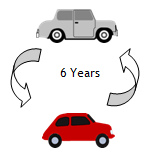
I was taught to set goals that are challenging but achievable. Accordingly, I set a goal to keep a car for 12 years before burying it. A few decades ago that would have been unrealistic but thankfully today’s vehicles, if properly maintained, can run for 200,000 miles or even more.

This is good news for the frugal. It enables us to lower our car costs and free up cash flow by spreading out and staggering vehicle purchases. For example, if you live in a 2-car household, here’s a schedule to consider following (it’s the one my wife and I follow): Read more »

Cashflownavigator Newsletter – September 2012


In This Issue:

CASHFLOWNAVIGATOR BLOG: Free Up Cash Flow by Rotating the Use of Your Credit Cards

CASHFLOWNAVIGATOR BLOG: Want to Cut College Costs?  Start by Looking at the Biggest Slices

GUEST BLOG: Suze Orman’s Top Four Money Mistakes You Can’t Afford to Make

CASHFLOWNAVIGATOR BLOG: Free Up Cash Flow by Rotating the Use of Your Credit Cards

Give Yourself up to 1 ½ Months of Interest-free “Float”

I once took an accounting course taught by the owner of a retail toy store.  From what I recall his demeanor wouldn’t have endeared him to many children (or to many students for that matter), but he did impart some pearls of financial wisdom that I still remember and try to apply when managing my own finances.  One was, “A dollar in your pocket today is worth more than a dollar a year from now.” This was his favorite one, and for good reason.  You see, a toy store lives or dies based on how effectively its cash flow is managed, because over 50% of annual sales often occur during a 1-month holiday shopping season.  So it has to survive the other 11 months on a cash flow diet.

Read More

SPOTLIGHT ON: Your Financial Dashboard

Now when you log in to Cashflownavigator you’ll see a dashboard showing your net worth and cash flow totals, and how much ahead or behind you are on your current 80/20 Goaltracker savings goal.


Also, if you haven’t yet completed filling in your 80/20 Worksheet, the Worksheet Status Bar shows you how much progress you’ve made so far.

Want to fill in some more of your Worksheet?  Just click the “Create or Update 80/20 Worksheet” button at the top of the page.  Or if it’s time to update your Goaltracker savings amount, select the “Create or Update Goaltracker Goal” button.

We hope you find this enhancement helpful.  As always, we welcome your feedback and ideas to help us improve Cashflownavigator resources.  Post your comments on the site or our Facebook page, or email us at feedback@cashflownavigator.com.

CASHFLOWNAVIGATOR BLOG: Want to Cut College Costs? Start by Looking at the Biggest Slices

It now costs an average of $21,447 a year to attend an in-state public college, and over $42,000 a year for a private college.  To make matters worse, these costs are rising rapidly.  During the past decade they rose 5.6% per year faster than inflation. (1)  That’s a nasty combination, particularly if you’re the one paying the bill.

If you’re a student paying your own way this extra cost could jeopardize your ability to get ahead of debt at an early age.   If you’re a parent paying for your children’s education the additional obligation might set you back on your path to financial freedom, perhaps by years.

This expense is too big to accept without looking for ways to reduce it. Here are a few ideas to consider.

Read More

GUEST BLOG: Suze Orman’s Top Four Money Mistakes You Can’t Afford to Make

In a recent episode of America’s Money Class with Suze Orman she reveals four financial mistakes that could haunt you forever.  She explains what not to do when it comes to mortgages, student loans, debit cards and short-term investing.  Here’s a closer look.

Read More

Check out these and other great articles on our Facebook page!


Want to Cut College Costs? Start by Looking at the Biggest Slices.

It now costs an average of $21,447 a year to attend an in-state public college, and over $42,000 a year for a private college.  To make matters worse, these costs are rising rapidly.  During the past decade they rose 5.6% per year faster than inflation. (1)  That’s a nasty combination, particularly if you’re the one paying the bill.

If you’re a student paying your own way this extra cost could jeopardize your ability to get ahead of debt at an early age.   If you’re a parent paying for your children’s education the additional obligation might set you back on your path to financial freedom, perhaps by years.

This expense is too big to accept without looking for ways to reduce it.  Here are a few ideas to consider. Read more »

Cashflownavigator Newsletter- July 2012

In This Issue:

CASHFLOWNAVIGATOR BLOG: Getting Ahead Early, Part 2: Open a “Team Savings and Investment Account”

SPOTLIGHT ON: The Navigator Tracking Tool

CASHFLOWNAVIGATOR BLOG: Wealth and Cash Flow Lessons from Shark Tank

CASHFLOWNAVIGATOR BLOG: Getting Ahead Early, Part 3: Moving Forward in the Financial Life Cycle with the Help of Rental Income

GUEST BLOG: How to Retire Early and in Style – Without a Fortune!

by Laura D. Adams
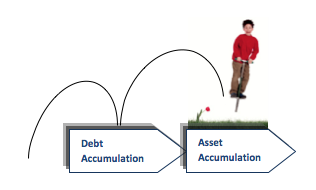
CASHFLOWNAVIGATOR BLOG: Getting Ahead Early, Part 2: Open a “Team Savings and Investment Account”The previous article on this topic focused on how important it is for young adults to “outrun” debt and move quickly from Debt Accumulation to the Asset Accumulation stage of the Financial Life Cycle. The name of the game is to get a good head start… to move through the early stages of the life cycle as fast as possible because doing so enables you to reach the final stage, financial independence, at a younger age. That was the concept. This article focuses on execution. Here we offer one idea to help reduce the amount of time young adults spend in Debt Accumulation, or to even bypass the stage altogether.

Read More

SPOTLIGHT ON: The Navigator Tracking Tool.  A runner-up choice for our tagline was “Financial Independence, One Goal at a Time.”  That’s actually a description of just one part – the last part – of the Cashflownavigator system: using the Navigator Tracking Tool.

Setting a goal, and using the Navigator Tracking Tool to achieve it, completes a Cashflownavigator cycle.  The cycle begins with filling in your 8020 Worksheet™, which captures your assets and liabilities (wealth) and all your monthly cash flows.

Read More

CASHFLOWNAVIGATOR BLOG: Wealth and Cash Flow Lessons from Shark TankAt the end of a busy week I look forward to winding down by watching…five human sharks attack unsuspecting start-up entrepreneurs.  Alright, that’s a bit overstated.  For those of you who haven’t yet seen it, “Shark Tank” is a reality show where early stage entrepreneurs seek funding from five successful and very wealthy business owners.


Read More

CASHFLOWNAVIGATOR BLOG: Getting Ahead Early, Part 3: Moving Forward in the Financial Life Cycle with the Help of Rental Income


OK, so let’s say you’re in your 20s and with the help of a family savings and investment account (see Part 2 of this series) you have little or no debt and $20-25,000 in liquid accounts (savings, stock).  What can you do to build on your momentum and start generating monthly cash flow from a source other than your salary?  One option to consider is a rental property.


Read More


GUEST BLOG: How to Retire Early and in Style – Without a Fortune!

by Laura D. Adams


We like how in this article Laura D. Adams, author of “Money Girl’s Smart Moves to Grow Rich” (an EIFLE award winner), focuses on reducing the cost of one big-impact item to help make retirement more affordable.  Laura’s website is www.lauradadams.com


Read More

Check out these and other great articles on our Facebook page!

Cashflownavigator Newsletter- May 22, 2012

We are looking for honest feedback! Enter our “How Are We Doing?” survey sweepstakes to win a Kindle or Amazon.com Gift Card!

To be eligible to win one of our three great prizes, please make sure you “Like” us on Facebook and are also a registered member of Cashflownavigator. The deadline for completed surveys is June 15th, so please make sure to register by then. Head on over to our Facebook page to enter. Good luck to all!

In This Issue:

CASHFLOWNAVIGATOR BLOG: Ideas to Help Our Youth Get a Strong Financial Head Start

Part 1: Outrun the Debt   or   Don’t Be A Pickle!

SPOTLIGHT ON: New Cashflownavigator Features!

CASHFLOWNAVIGATOR BLOG: For Guidance on Your Retirement Account Strategy, Consider Einstein’s Theory – Compounding Compound Interest

CASHFLOWNAVIGATOR BLOG: Cash Flow is Better, But Wealth is Still Good

GUEST BLOG: Is Debt Snowball the Best Way to Pay Off Debt?

By Ryan Guina at CashMoneyLife

CASHFLOWNAVIGATOR BLOG: Ideas to Help Our Youth Get a Strong Financial Head StartPart 1: Outrun the Debt   or   Don’t Be A Pickle!

In an earlier article I quoted James Taylor, but since the topic here is youth let’s borrow a line from James’s younger brother Livingston:  “I could barely hobble when I needed to run.”  What does that have to do with America’s youth getting ahead?  Well, when it comes to their finances, hobbling is what most of our children find themselves doing as they enter adulthood, mostly due to high levels of debt.  But it doesn’t have to be that way.  It’s still possible for them to move through the dangerous Debt Accumulation stage of the Financial Life Cycle quickly – if they run a smarter race.


Read More

SPOTLIGHT ON: New Cashflownavigator Features!We’ve added three new 8020 Worksheet features:

Look up the current value of your home while filling in your 8020 Worksheet, using our Zillow link.

Look up the value of your vehicles while filling in your 8020 Worksheet, using our Edmunds link.
View our new 8020 Worksheet tutorial videofor tips on using the worksheet.

Read More

CASHFLOWNAVIGATOR BLOG: Unsure About Retirement Account Contributions? Consider Einstein’s Theory – Compounding Compound InterestI’ve always admired Albert Einstein.  After all, he was a fairly intelligent fellow.  In science, he changed our understanding of light and of gravity, helped prove the existence of molecules, and explained the nature of space and time.  In politics, he was influential as a promoter of peace and freedom.  All in all, a very strong resume’.  But for our purposes, his most impressive contribution was in the field of finance.


Read More

CASHFLOWNAVIGATOR BLOG: Cash Flow is Better, But Wealth is Still GoodYou might have noticed that we devote much of our time and attention to the topic of cash flow.  It’s the lead subject of our e-booklet, a key component of our measurement tool, and is regularly featured in our blog articles. We do this in large part because cash flow tends to be neglected in most personal finance plans and resources.  Instead, the focus is usually on wealth building…increasing your net worth.


Read More

GUEST BLOG: Is Debt Snowball the Best Way to Pay Off Debt?By Ryan Guina at CashMoneyLife 

Read this useful article about Debt Reduction using the link on our Facebook page!


Read More

Check out these and other great articles on our Faceb

Spotlight On…The Navigator Tracking Tool

A runner-up choice for our tagline was “Financial Independence, One Goal at a Time.”  That’s actually a description of just one part – the last part – of the Cashflownavigator system: using the Navigator Tracking Tool.

Setting a goal, and using the Navigator Tracking Tool to achieve it, completes a Cashflownavigator cycle.  The cycle begins with filling in your 8020 Worksheet™, which captures your assets and liabilities (wealth) and all your monthly cash flows.

Having measured your wealth and cash flow in the 8020 Worksheet™, your next step is to apply the principles from our free e-booklet, Wealth is Good, Cash Flow is Better©, to help you identify your next financial goal.  In general, that goal involves saving to either pay off a liability (a vehicle, credit card debt, a student loan, etc.) or to acquire a “Best” asset type (an asset that either appreciates in value or generates positive cash flow, or does both).

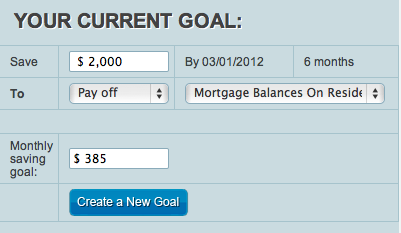
Once you’ve decided on your goal, the last step is to use the Goaltracker tool to establish a disciplined process for saving up and achieving it.  This requires a specific dollar amount to save, and a defined time period – a deadline – by which you are to complete the task.

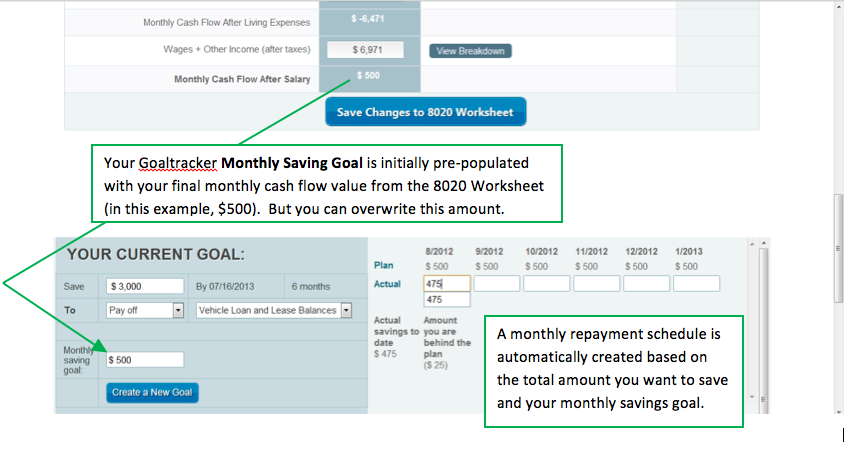
To set a goal in the Navigator Tracking Tool just choose the liability from the drop-down menu you want to pay off, or the asset you want to acquire.  Then enter the total amount you’ll need to save to accomplish the goal.  For example, in the illustration above the goal is to save a total of $3,000 to pay off a vehicle loan or lease.

All that’s left now is to decide how much per month to save to pay off this $3,000 debt.  We get you started with a recommended amount, $500 per month in this example.  That’s the amount you should be able to save each month based on cash flow values in your 8020 Worksheet™.   But you can change this by typing in a new amount.

With both the total and monthly savings amounts defined, the Navigator Tracking Tool calculates how many months it should take you to accomplish the goal (6 months), and it creates a calendar to help you manage the process.  At the end of each month, simply fill in the actual amount you’ve saved, and the Navigator Tracking Tool will add up the Total Actual Amount you’ve saved so far, and how much ahead or behind schedule you are.

And that’s it…that completes the cycle.  Once you’ve accomplished this goal, you’re ready to reassess your 8020 Worksheet™ and choose your next goal.  Use the Navigator Tracking Tool to achieve that one, and with each one you will move another step closer to financial independence.

Getting Ahead Early, Part 3: Moving Forward in the Financial Life Cycle with the Help of Rental Income

Creating a Cash Flow Source in Your 20s or 30s

OK, so let’s say you’re in your 20s and with the help of a family savings and investment account (see Part 2 of this series) you have little or no debt and $20-25,000 in liquid accounts (savings, stock).  What can you do to build on your momentum and start generating monthly cash flow from a source other than your salary?  One option to consider is a rental property.

As explained in our e-booklet Wealth is Good, Cash Flow is Better©, a rental property is an example of a “Best” asset type because it can appreciate in value AND generate positive monthly cash flow (from the rental income).  A single family primary residence on the other hand is a “2nd Best” asset;  for while it also appreciates over the long term it always creates a negative cash flow. (Even if the mortgage is paid off, property taxes and homeowner’s insurance keep you in negative territory.)

Read more »

Getting Ahead Early, Part 2: Open a “Team Savings & Investment Account”

The previous article on this topic focused on how important it is for young adults to “outrun” debt and move quickly from Debt Accumulation to the Asset Accumulation stage of the Financial Life Cycle. The name of the game is to get a good head start… to move through the early stages of the life cycle as fast as possible because doing so enables you to reach the final stage, financial independence, at a younger age. That was the concept. This article focuses on execution. Here we offer one idea to help reduce the amount of time young adults spend in Debt Accumulation, or to even bypass the stage altogether. Read more »

© copyright 2026. CashflowNavigator
Web Design & Development by: Dotcomweavers
Powered by WordPress | Designed by: backlinks | Thanks to Haftetiketten, car insurance and how to fall asleep